
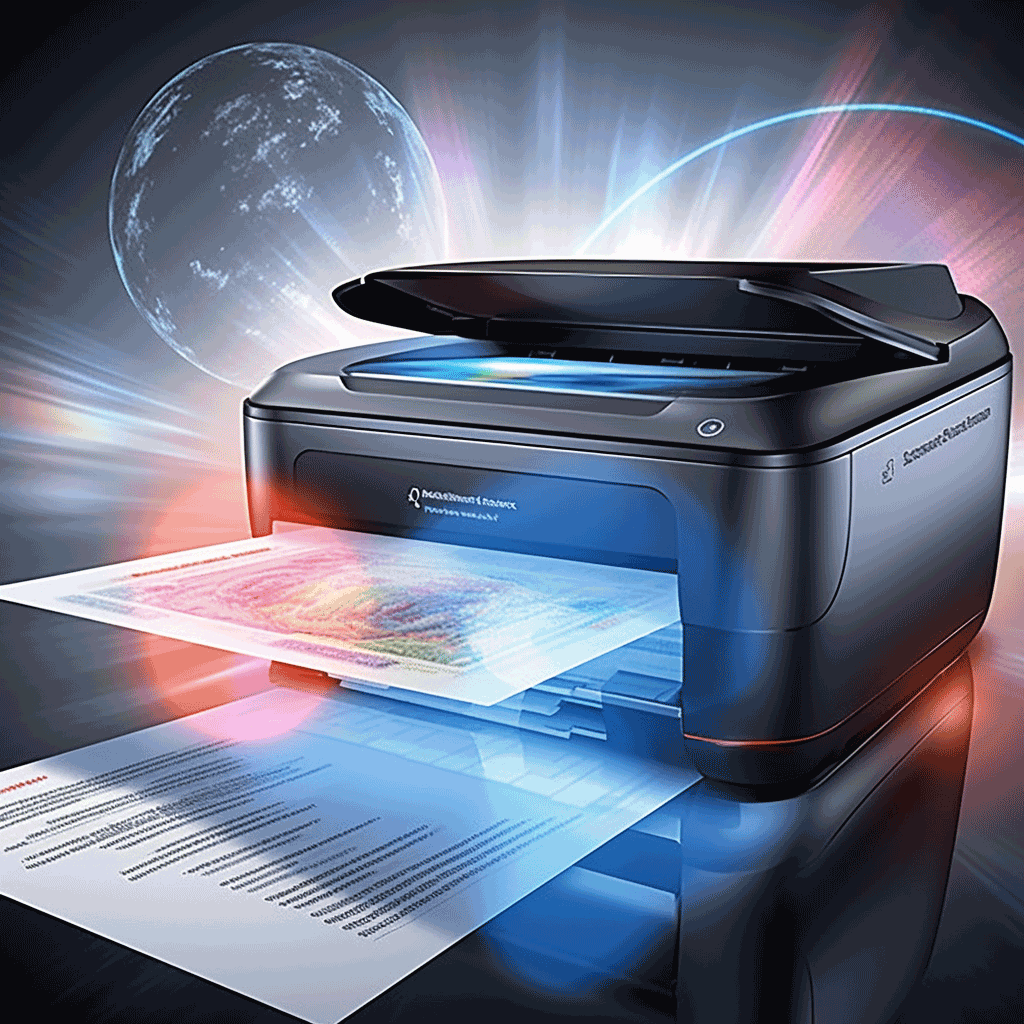
In today’s digital age, the printer has become one of the indispensable tools in our work and life. One of the most common types of printers is a laser printer. But do you really understand what a laser printer is, and how it works? In this paper, we will deeply explore the working principle, advantages and application fields of laser printers.
A laser printer is a device that uses laser technology to convert digital images or documents into an actual printout. It achieves high-quality printing by drawing images or text successively on printed paper using a laser beam. Here is how laser printers work:
Transfer data: Like any other type of printer, the laser printer first receives the data to be printed. The data can be derived from computers, laptops, smartphones, or other digital devices.
Page Description Language (Page Description Language, PDL): Data is usually sent to the laser printer in the form of a page description language (such as PostScript or Printer Control Language). PDL is a standard language describing page layout, fonts, colors, and other elements.
Processing data: The processor inside the laser printer receives and parses the PDL data. It converts data into a format the printer understands and stores it in the printer’s memory.
Laser beam scanning: Once the data is ready, the laser printer begins working. It uses a laser beam to scan the surface of the printed paper. The laser beam moves along the width of the paper during printing and switches according to the image or text requirements to create pixels or points on the paper.
Electrostatic transfer: When a laser beam scans the printing paper, it interacts with a component called the photosensitive drum inside the printer. The photosensitive drum is coated with a special chemical that is activated by the charge where struck by the laser beam.
Powder adsorption: Once the area on the photosensitive drum is activated, the printer will adhere to the activated area through a developer drum containing a colored powder (usually a toner).
Transfer process: When the toner is attached to the area of the photosensitive drum, the printing paper is transmitted above the photosensitive drum. A roll called the “transfer roll” is used to transfer the toner from the photosensitive drum and onto the printing paper. The transfer roller puts pressure on the print paper to attach the toner to the paper, thereby creating an image or text.
Curing process: Once the toner is transferred to the print paper, the paper is transferred to a part called a “curder”. The high temperature and pressure in the curder help the toner blend into the paper to ensure that the printing quality is durable and durable.
Complete printing: Once printing is complete, the print paper is delivered to the output tray of the printer. Users can remove the printed file and use it.
Laser printers have many advantages over other printing techniques. First, they offer a high-quality printout with clear detail and bright colors. Secondly, the laser printing speed is fast and suitable for a large number of printing tasks. In addition, the cost of laser printer consumables is relatively low, and the printing cost is more economical. Moreover, they usually have high reliability and durability, and can work steadily for long periods of time.
Laser printers are widely used in various fields. In office environments, they are used to print documents, contracts, reports, and other office documents. In the field of education, teachers and students can use laser printers to print textbooks, courseware, and research papers. In addition, laser printers are also widely used in creative industries such as art, design and photography to obtain accurate and high-quality image output.
In summary, a laser printer is a device that uses laser technology to convert digital images or documents into an actual printout. It achieves high quality printing through the process of laser beam scanning and toner transfer. Laser printer has the advantages of high quality, high speed, economy and a wide range of applications, making it one of the indispensable tools in modern office and life.