
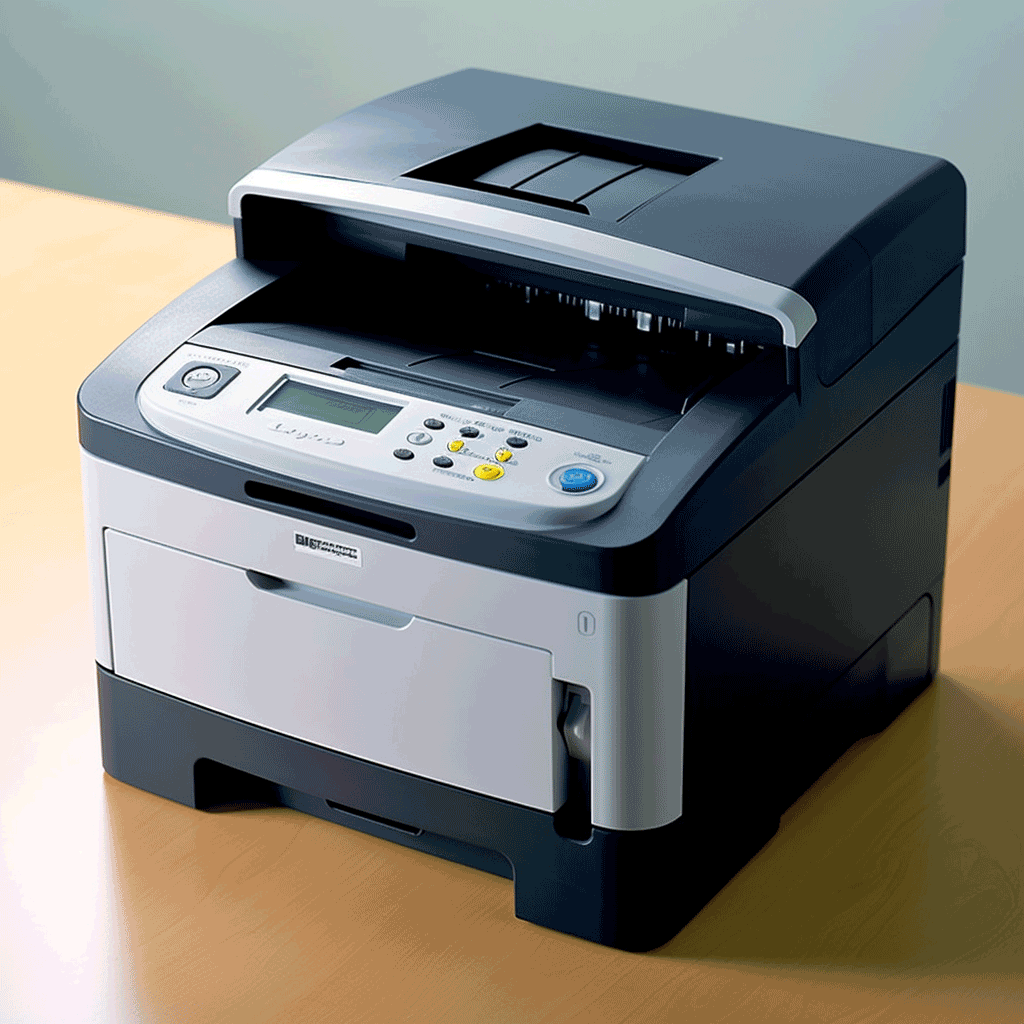
Introduction: Laser printer is one of the common printing equipment in our daily life and office environment. But, many people are curious about how laser printers work. This article will delve into how a laser printer works to help you better understand how it turns digital information into a printout.
Light guide process:
The laser printer uses a laser beam to transmit images and text messages. This laser beam is guided through the lens and reflector in the optical guidance system.
And the laser beam to accurately scan the surface of the photosensitive drum (photosensitive drum).
Electrostatic charge and photosensitive drum:
The photosensitive drum is one of the key components of a laser printer. It is a metal or plastic drum coated with special photosensitive substances, which ts light energy into electricity.
When the laser beam scans the surface of the photosensitive drum, the photosensitive substance is excited, generating a charged electrostatic charge.
Ink powder transmission:
The laser printer uses toner (toner) to generate images and text. Toner is usually stored in toner cartridges.
When the surface of the photosensitive drum has an electrostatic charge, it attracts the toner particles and adheres the toner to the corresponding position on the surface of the photosensitive drum.
Transfer process:
To transfer the toner from the photosensitive drum to the paper, the laser printer uses a transfer roller with a positive charge.
When the paper passes through the transfer roll, the positive charge will attract the toner, transferring the toner from the photosensitive drum to the paper.
Melting and fixing:
Once the toner is transferred to the paper, it needs to be melted and fixed to the paper.
Laser printers do this through a combination of heating and pressure. Usually, after the toner transmission, the paper passes through a heating roll to melts the toner and combines with the paper surface.
Cleanup and reset:
After completing the printing task, the toner remaining on the photosensitive drum needs to be cleaned up. A laser printer is typically equipped with a cleaning unit that removes the residual toner from the photosensitive drum.
The printer will also reset to restore the photosensitive drum and other components to the initial position for the next printing task.
navar:
The work of the laser printer is managed by a control system. The system receives printing instructions from a computer or other equipment, and controls the operation of the laser beam, photosensitive drum, toner transmission, and other associated components.
The control system is also responsible for monitoring the status of the printer, toner and paper supply, and providing a user interface for setting printing parameters and handling printing errors.
Conclusion: The laser printer transforms the digital information into print output through the laser beam, photosensitive drum, toner transmission, transfer printing and fixation processes. Precise control of the laser beam and electrostatic charge transfer on the photosensitive drum allow the toner to adhere to the photosensitive drum and transmit it to the paper via the transfer roll. Finally, the toner was fixed to the paper by the melting and fixation process. The laser printer is controlled for managing the entire printing process and providing a user interface. By gaining insight into how laser printers work, we can better understand their functions and performance, and use and maintain them better.